A gantry router builder running a 1.2 m long, 40 mm ball screw at 2,500 rpm called after six weeks of two-shift production. Backlash on the X axis had crept from 0.008 mm to 0.035 mm, and the bearing housing at the thrust end was running about 8 degrees C above the machine frame. Nothing had broken. Steel expands roughly 0.0115 mm per metre per degree C, so that screw was growing by about 0.1 mm between a cold Monday morning and a warm Friday afternoon, and because both ends had been clamped with axially located bearings, all of that growth had to be absorbed somewhere.
The lesson is the same one that comes up in most ball screw support bearing enquiries: the bearing is the last decision, not the first. Decide how the screw will be located axially, how much preload the thrust pair needs, and how the free end will be allowed to float. Then choose part numbers.
What Each End of the Screw Actually Has to Do
The short answer: one end fixes the screw axially and carries the thrust, the other end supports it radially and lets it move. A support bearing set is not two identical bearings chosen for convenience, it is a pair of components with different jobs, and the failure patterns are different too.
Fixed and floating end duties on a typical ball screw axis, with the symptoms of a mismatched choice.
| Position |
Primary duty |
Typical bearing choice |
What goes wrong if mismatched |
| Fixed (thrust) end |
Locates the screw axially, carries cutting and acceleration thrust, sets preload |
Matched angular contact pair, back-to-back, or a double row angular contact unit |
Axial play that grows with load, hot housings, fretting on the shaft shoulder |
| Floating (support) end |
Carries radial load only, allows thermal expansion and contraction |
Deep groove ball bearing with the outer ring free to slide in its housing |
Bowed screw, brinelled races, thrust pair overloaded as the screw warms |
| Motor or gearbox end |
Transfers torque, absorbs coupling misalignment |
Radial bearing sized for its own load only |
Coupling forces pushed into the support bearings, vibration at speed |
A quick sanity check for any new design: measure the distance between the two bearing seats in millimetres, divide by 1000, multiply by the expected temperature rise in degrees C, and multiply by 11.5. The result, in microns, is the axial travel the floating end must be able to absorb. On a 2 m screw with a 5 degree rise that is already around 115 microns, which is far more than any preload can swallow.
Choosing the Fixed-End Pair
Three arrangements cover most machine tool and automation work, and the choice usually comes down to speed, rigidity and how much axial space the housing can spare.
- Back-to-back (DB) angular contact pair: the widest load spread between the two contact points, good resistance to bending moments, and the standard choice for screw thrust ends.
- Face-to-face (DF) pair: tolerates a little more misalignment but has a narrower load spread, so it flexes more under moment load.
- Tandem (DT) pair: both bearings share thrust in one direction, used only when the thrust is heavy and one-directional and a second pair closes the loop elsewhere.
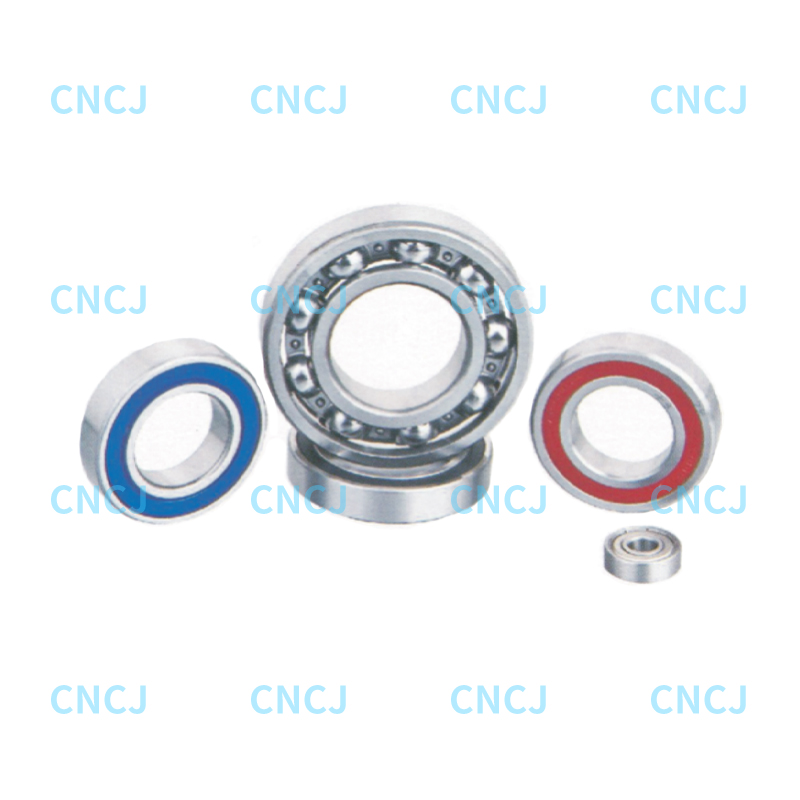
Ball screw support bearings are commonly built with a 60 degree contact angle, because the priority is axial rigidity rather than radial capacity. Universally matched pairs are supplied with a defined preload already ground in, so the pair must be mounted as a set and never mixed with another pair from a different box. If the design needs a single compact unit instead of two separate rings, a double row angular contact bearing does the same locating job in one housing seat and takes combined radial and thrust load; our
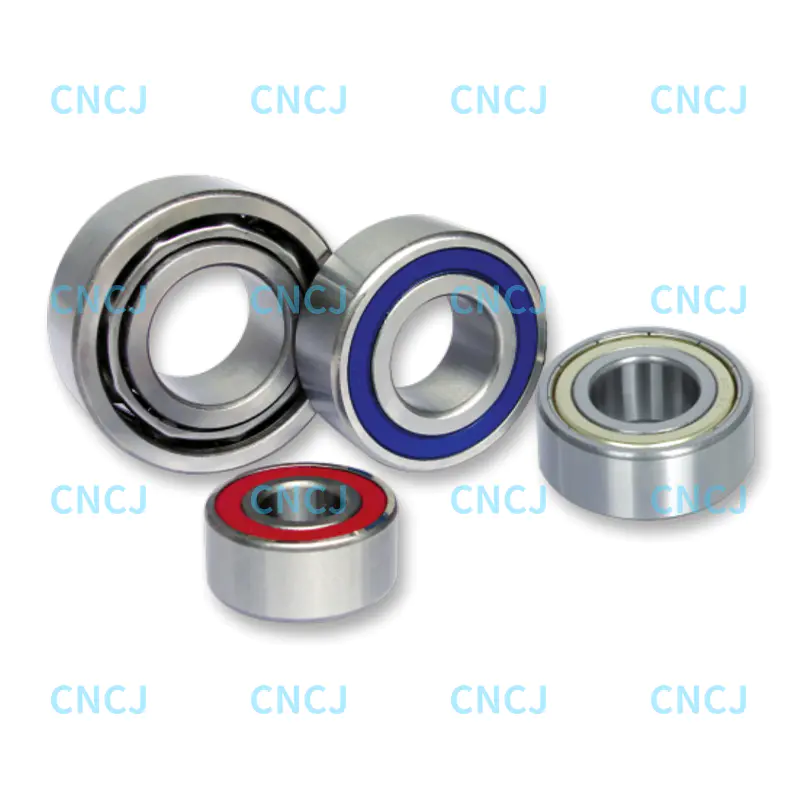 52 and 53 Series Double-Row Angular Contact Ball BearingsA compact single-housing alternative for combined radial and axial locating, with sealing and lubrication options for machine-tool, wind-power, hub and pump uses.View Product →
page lists the 52 and 53 series sizes used in this role. The trade-off is that the preload is fixed at manufacture, so axial rigidity cannot be tuned afterwards.
Preload: Where Most Support Bearing Problems Start
Preload removes internal clearance and makes the screw position repeatable, but it is a narrow window. As a working starting point, light preload sits around 1 to 2 percent of the pair's dynamic load rating and medium preload around 3 percent; anything beyond that usually raises running temperature faster than it raises stiffness. The practical test is simple: after a 30 minute run-in, housing temperature should stabilise, not keep climbing, and the axial play measured with a dial indicator at the screw end should read zero with a repeatable return to position.
Two mistakes dominate. First, using a locknut to add preload that should have been ground into the pair, which crushes the inner rings and produces a bearing that is stiff when cold and seized when hot. Second, applying heavy preload to a screw that has no floating end, which turns thermal growth into a thrust load of several hundred newtons. The reasoning behind tolerance bands and torque values is set out in more detail in our note on selecting preload for 52 and 53 series bearings, and the same logic applies to matched angular contact pairs.
The Floating End Deserves a Real Bearing
The floating end is often treated as an afterthought, and that is where quiet failures come from. It has to carry the radial load of the screw plus the weight of the nut and carriage, keep the screw concentric with the thrust end, and still slide axially without scuffing its seat. A deep groove ball bearing with a locating fit on the shaft and a sliding fit in the housing is the usual answer, with the outer ring free to move perhaps 0.3 to 0.5 mm each way and nothing clamping it in the bore.
Two details matter more than the catalogue page. The housing bore must be round and smooth enough that the outer ring slides rather than tilts, and the bearing must not be a preloaded type, because any axial constraint at this end defeats the whole arrangement. Standard
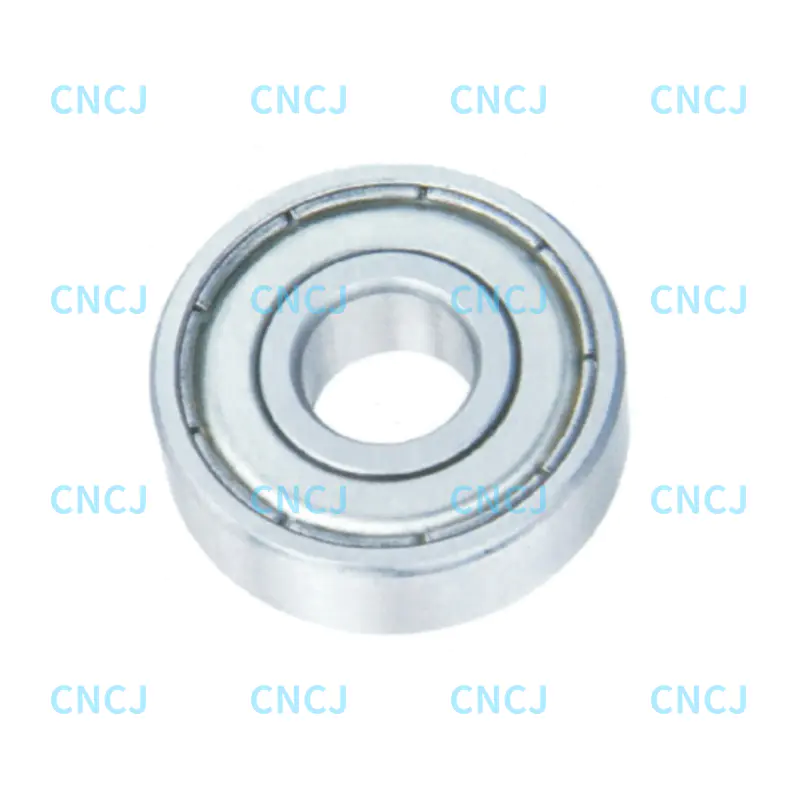
 Deep Groove Ball Bearings in 42 and 43 SeriesFor non-preloaded locating seats, this category covers 42 and 43 series deep groove ball bearings with standard sizes and clearance options for warm housings.View Product →
sizes cover most support seats, and a C3 clearance is often a sensible choice where the housing warms up faster than the shaft.
When the Workshop Is Dusty or Wet
Machine enclosures are not clean rooms. Cast iron dust, coolant mist and washdown water all find their way into a support housing, and an open bearing that survives on the test bench can fail within a season on the shop floor. Sealed and shielded variants of the same bearing families solve most of this without changing the housing envelope, and a 2RS contact seal is a better choice than a ZZ shield wherever coolant is present, because a shield only deflects debris rather than sealing it out. Our
 32 and 33 Series Double-Row Angular Contact BearingsSealed or shielded double-row units for dirty support housings, combining radial and axial load capacity with 30-degree contact angle and compact locating.View Product →
range is used where a compact locating unit must also survive dirty conditions, and the 30 and 38 series with 2RS or ZZ closures give the same axial locating function in a narrower width for tight housings.
Mounting Sequence That Prevents Early Failure
Most support bearing complaints that reach a manufacturer are assembly issues rather than manufacturing issues. The sequence below is the one we recommend for a matched pair at the thrust end.
- Clean the shaft seat, housing bore and spacer faces, then check the shoulder runout with a dial indicator; 0.002 to 0.005 mm total is a reasonable target for a precision axis.
- Check spacer parallelism on a surface plate. A spacer that is 0.01 mm out of parallel tilts the outer ring and quietly adds several hundred newtons of uneven preload.
- Fit the pair in the marked order, keeping the matching marks aligned exactly as supplied; reversing one ring changes the preload and the load line.
- Lightly oil the locknut thread before tightening, so that applied torque turns into clamping force instead of friction in dry threads, then tighten in two or three steps to the specified value.
- Measure axial movement with a dial indicator against the screw end while pushing and pulling by hand, then repeat with a lever at moderate load to confirm the reading does not grow.
- Run in at increasing speed, watching housing temperature; a stable reading after 30 to 60 minutes is the pass criterion, a continuing climb is not.
Points to confirm before the first cut
- Only one end is axially located. Two located ends is the single most common cause of premature thrust bearing failure.
- Preload matches the duty: light for high speed and long life, medium for heavy cutting and rigidity, never "as tight as it will go".
- Lubrication quantity is measured, not guessed. Over-greasing a small support bearing churns and overheats just as fast as no grease at all.
- Coupling alignment is checked after the bearings are clamped, not before.
A Short Purchasing Checklist
When a support bearing is specified, the enquiry needs more than a bore and outside diameter. Buyers who supply the following get a usable quotation the first time:
Information that changes the bearing offered for a ball screw support position.
| Item |
Why it changes the part |
| Axial thrust with a safety factor |
Sets whether a matched pair or a single double row unit is adequate |
| Required axial rigidity |
Decides preload class and contact angle |
| Maximum speed and duty cycle |
Drives cage type, lubrication and seal choice |
| Accuracy class and runout limit |
Separates a standard precision pair from a P4 class set |
| Environment |
Open, shielded or contact sealed; grease type and fill quantity |
| Housing dimensions |
Rules out arrangements that physically will not fit the seat |
Ask for the pair to be supplied as a matched set with the preload marked on the packaging, and keep that set together through goods-in, stores and assembly. Mixed pairs are the quietest way to lose the rigidity that was paid for.
Support bearings on a ball screw are a small part of the machine and a large part of its repeatability. Get the arrangement right, one end located and one end free, give the thrust pair a preload it can live with, and keep the floating end genuinely free. The bearings themselves are rarely the weak link; the decisions around them usually are.
 English
 中文简体
 Deutsch
 Español